Twentieth Century Berlin on Film – The 1960s

Berlin in the 1960s - an escape attempt (screenshot from The Wall)

The 1960s was a decade of great social and technological advances and Berlin, as the main flashpoint between the ideologies of capitalism and socialism, saw more changes than most cities.

The loss of skilled workers to the West, as referred to in my Twentieth Century Berlin on Film – The 1950s post led the government of East Germany to take the extraordinary step of sealing its borders.  Officially referred to as the Anti-Fascist Protection Rampart the Berlin Wall was built to halt an exodus that threatened to de-stabilise the fledgling state.

In 1963 the eyes of the world were on Berlin when the President of the United States of America, John F Kennedy, stood in front of the Rathaus Schöneberg and, in a show of solidarity with the people of West Berlin declared “Ich bin ein Berliner”.

“Niemand hat die Absicht eine Mauer zu errichten” – Walter Ubricht (1961)

At a press conference on 15 June 1961 in response to a question from a West German journalist, Walter Ulbricht, the leader of East Germany, uttered the now immortal words, “Niemand hat die Absicht eine Mauer zu errichten” – in English, ‘No one has any intention to erect a wall’.

The Wall – US Propaganda Film – Berlin Wall 1962

Less than two months later, in the night of 13 August 1961, East German soldiers began the process of marking out the border and rolling out barbed wire to prevent unauthorised movement between East and West Berlin.

The US propaganda film, The Wall, from 1962 includes some of the most iconic footage of the recently divided city – the scene at 6:23 where a woman runs into the barbed wire at the border makes me wince every time I watch it but is a clear indication of the desperation to leave.

A Royal Day in Berlin (1965)

Queen Elizabeth II travels to West Berlin in 1965, the first visit of a British monarch to Germany for more than half a century.

Berlin in Bildern – Hauptstadt der DDR (1968)

This clip from Das war die DDR shows Berlin in 1968 and includes footage of the Rotes Rathaus, the Soviet Memorial in Treptower Park and most notably the Fernsehturm still under construction.

Checkpoint Charlie, Berlin “Counter-Intelligence Special Operations” (1969)

Taken from a US Army training film this footage from 1969 shows Checkpoint Charlie and other notable Berlin sights and outlines procedures for observing East Germans and other potential threats in Berlin.

Photos From My Phone – April

At the end of March I finally got around to upgrading my iPhone 3GS to an iPhone 5 and as a result I’ve been taking a lot more photos with my phone whilst I’m out and about in Berlin.

It was at the start of April that I really started to notice the sweet machines on the walls of the city.

Sweet Machine in Berlin

The ease of taking photos with my iPhone meant that I captured more of the interesting patterns in the city’s architecture like these coloured blinds contrasted against the concrete of a Kreuzberg building…

Colour Blinds in Berlin

…and a Plattenbau near Alexanderplatz.

Plattenbau at Alexanderplatz in Berlin

And I snapped scenes that caught my eye like these girls walking under the artwork in the U-Bahnhof at Schloßstrasse.

Artwork at U-Bhf Schloßstrasse in Berlin

A great new food event – Street Food Thursday at Markthalle IX – started in April in Berlin and means there’s more time to enjoy the incredible sandwiches, like this Beef Brisket, at Big Stuff Smoked BBQ

A Beef Brisket at Big Stuff Smoked BBQ in Markthalle IX Berlin

…which I followed up with cocktails at Würgeengel.

Daiquiri at Würgeengel - a Berlin Cocktail Bar

I spotted this cheeky monkey on my way to take pictures of one of the huge black & white portraits in JR’s Wrinkles of the City project in Berlin.

Cheeky Monkey - Street Art by Unknown Artist in Berlin

As well as the JR exhibition at Galerie Henrik Springmann I would also highly recommend the Olympus OM-D Photography Playground at the Opernwerkstätten.  I took lots of photos of this wonderful installation by Korean artist, Jongmoon Choi.

Olympus OM-D Photography Playground in Berlin

Another consequence of taking more phone photos is that I have become more fond of Instagram and the breathtaking photos of Miss Underground inspired me to look for empty spaces in the Berlin U-Bahn like the exit at U-Bhf Klosterstrasse.

U-Bhf Klosterstrasse in Berlin

And finally, sunset season is well and truly underway in Berlin.  Seeing the pink skies out of my window I grabbed my phone and captured this sunset over Mauerpark from my balcony.

Berlin sunset over Mauerpark from my balcony

If you’d like to keep up with my continued exploration of Berlin in real-time follow me on Instagram.

Twentieth Century Berlin on Film – The 1950s

Berlin in the 1950s - East Berlin Parade 1950

Throughout the 1950s the government of the DDR (Deutsche Demokratische Republik) continued a process of Socialisation in East Germany.  Tensions were running high between the East and West and also amongst the people of the DDR.  The ‘brain drain’ had started, as workers sought out the higher pay and better working conditions in the West.

East Berlin Parade 1950

The Freie Deutsche Jugend (FDJ) (Free German Youth) marching through East Berlin in 1950.

East Germany Propaganda – East Berlin 1950

There is more footage of the FDJ gathering in Berlin in 1950 with commentary (auf Deutsch) in this longer film.

DDR im Film XVII – Stalinallee (1951)

Set to the song Jugend erwach (Bau auf, bau auf), Part 17 of the series DDR – Das Original shows the construction of buildings on the Stalinallee, now Karl-Marx-Allee.

GDR Uprising (1953)

What started as a strike by construction workers in East Berlin the previous day turned into a full-scale uprising against the government of the DDR on 17 June 1953.  Workers were protesting against plans to increase working hours or cut pay and the policy of prioritising heavy industry that meant a shortage of consumer goods and power.

Legendary Sin Cities – Berlin: Metropolis of Vice

Berlin - Metropolis of Vice (screenshot from the Legendary Sin Cities documentary)

Metropolis of Vice, an episode from the Legendary Sin Cities documentary series focuses on the potent mix of sex and entertainment in the Weimar era Berlin of the 1920s.

“Its very name became synonymous with perversion, debauchery and creativity. Berlin in the 1920s was the sex capital of Europe.”

In response to the hyperinflation of the 1920s, driven by poverty, the sex trade in Berlin exploded as a means to put food on the table.

“Berlin was what sexual daydreams wanted to be.  You could find almost anything there and maybe everything.”

In this environment, performers such as Claire Waldoff, Anita Berber and Marlene Dietrich thrived and became stars.  Word of Berlin’s raucous nightlife and attitude of sexual freedom spread and drew more artists and creative people to the city.

I first posted this documentary on Facebook and Twitter 6 months ago before I began my Sunday Documentary series.

Legendary Sin Cities – Berlin: Metropolis of Vice

JR – Wrinkles of the City in Berlin – Part 2

JR - Wrinkles of the City Berlin 12

Wrinkles of the City by French street artist, JR is undoubtedly one of the most exciting street art projects to hit Berlin.

Since I first saw his crew pasting one of the artworks at Warschauer Strasse a few weeks ago, photos of JR’s pieces have been regularly appearing in my Instagram and Twitter feeds.

Since I wrote my JR – Wrinkles of the City in Berlin post last week I’ve seen a few more of the photographs of Berlin residents on my wanders around Berlin.

JR - Wrinkles of the City Berlin 13

JR - Wrinkles of the City Berlin 14

JR - Wrinkles of the City Berlin 15

You have until 25 May 2013 to see the Wrinkles of the City exhibition at Galerie Henrink Springmann in Berlin – a great opportunity to see more wonderful work by one of the world’s foremost street artists – JR.

Twentieth Century Berlin on Film – The 1940s

Berlin 1949 (screenshot from Mr Attlee Visits Berlin)

Continuing my Twentieth Century Berlin on Film series, footage of 1940s Berlin is dominated by the machinations and effects of the Second World War.  At the beginning of the decade the city is a focal point for Nazi marches and speeches.  During the war, the German capital is a prime target for the allied bombers and afterwards a flashpoint at the beginning of the Cold War.

Berlin 1940

The soldiers of the German Wehrmacht march through Berlin in 1940.  The streets are lined with people and Nazi flags fly from the Brandenburger Tor (Brandenburg Gate) and may of the buildings on the parade route.

Berlin 1943

By 1943 Berlin is showing the scars of war.  Heavy bombing raids have taken their toll on the city.  Rescued furniture and belongings line the streets and Potsdamer Bahnhof is out of use – the scenes of devastation inside make it clear why.

Berlin – May 12, 1945

This colour footage from 1945 shows the utter devastation of Berlin.  Many buildings are now just shells and huge piles of rubble line the streets – the chain gangs of Trümmerfrauen (rubble women) work hard to clean up the city.

Mr Attlee Visits Berlin – 1949

British Prime Minister Clement Attlee visited Berlin in 1949 to see first hand how West Berliners were coping with the effects of the Berlin Blockade.  This short film from the archive collection of the Alexandra Palace Television Society follows that visit.

Berlin Street Art Vol 10 – Various Artists

New pieces appear year round on the streets of Berlin but it has been noticeable that since the weather has improved more artists have been hitting the city.  With lots of great Street Art from ALANIZ, ALIAS, CAZ.L and El Bocho to name a few, the problem with compiling this post wasn’t finding good work but agonizing over what to leave out.

That just means that there’s plenty in the bag for more posts though.

ALIAS

It’s always good to find new work by ALIAS and I love the pieces that appeared in Mitte recently.

Game Over - Street Art by ALIAS in Berlin

Behind Bars - Street Art by ALIAS in Berlin

Batter Up - Street Art by ALIAS in Berlin

Peter Pink

This is the first time I’ve seen a Peter Pink piece for myself so the first time he’s appeared on andBerlin but I love the humour in his work that I’ve seen on his Facebook page and other blogs – especially his potatoes.

Angela Merkel - Muss Ja - Street Art by Peter Pink in Berlin

CAZ.L

I used a piece by Berlin based street artist CAZ.L in my Dog Lover post and here are a couple more paste-ups spotted in the city lately.  I don’t know much (read next to nothing) about the artist but check out the Facebook Page for updates.

Ride Into The Sun - Street Art by CAZ.L in Berlin

Adoration - Street Art by CAZ.L in Berlin

El Bocho

It would seem that El Bocho favourite Little Lucy has spent the winter coming up with a business plan – she’s still finding inventive ways to kill Kitti who is now on the menu.

Little Lucy Hanging Kitti - Street Art by El Bocho in Berlin

Little Lucy - Katzeneintopf - Street Art by El Bocho in Berlin

Little Lucy's Sandwich Shop - Street Art by El Bocho in Berlin

ALANIZ

As well as the usual paste-ups I’ve found a couple of huge ALANIZ paintings in Berlin lately. Painted with giant rollers you can see more new work in ALANIZ’s Flickr stream.

In Hiding - Street Art by ALANIZ in Berlin

The Blind Prophet - Street Art by ALANIZ in Berlin

No Child Is Born A Criminal - Street Art by ALANIZ in Berlin

Robi The Dog

I don’t know if Swiss artist Robi The Dog has moved to Berlin but I’ve seen new works from him regularly since last summer.

Mariachi Boy - Street Art by Robi The Dog in Berlin

.FRA

Plenty of paste-ups by Swiss street artist .FRA have appeared on walls and doors all over Berlin lately – I’ve seen them in Mitte, Friedrichshain, Prenzlauer Berg and Wedding.

Vado In Miniera - Street Art by .FRA in Berlin

Wanna Buff? (Mexican Wrestler) - Street Art by .FRA in Berlin

.FRA and Robi The Dog

These two Swiss guys have obviously been out pasting together and I love this combination.

Speak Louder & Leggy Zebra - Street Art by Robi The Dog & .FRA in Berlin

Stay tuned for more great Berlin Street Art soon.

Twentieth Century Berlin on Film – The 1930s

Berlin in the 1930s (Man drinking beer - screenshot from Berlin Reichshauptstadt 1936)

Berlin in the 1930s was witness to Hitler’s rise to power as Chancellor of Germany and subsequently many shockingly destructive and despicable acts like the book burning of 1933 and the Kristallnacht in 1938.  Continuing my Twentieth Century Berlin on Film series here are a few short videos that show Berlin in the 1930s.

Summer Holidays in Berlin (1930)

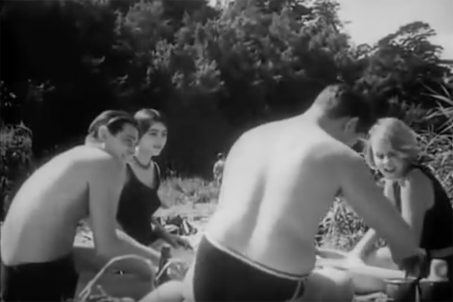
Despite the political changes and the economic difficulties in the country it is important to remember that it wasn’t all doom and gloom in Berlin.  In this clip, Berliners head out to enjoy the sunshine at the Wannsee.

Büchverbrennung (Book Burning) 1933

This clip from a documentary by the Deutsches Historisches Museum (German History Museum) shows the book burning at the Opernplatz (now Bebelplatz) in Berlin.

Goebbels denounces the authors of ‘un-German’ books as soldiers and students throw thousands of volumes onto a large bonfire.  Today a simple monument of empty shelves commemorates the events of 10 May 1933.

Alt-Berlin: Berlin – Wie es war

Alt-Berlin: Berlin – Wie es war (Old Berlin:Berlin – How it was) follows a horse and cart tour around the city with lots of information about the buildings and statues and life in Berlin in German.

Jesse Owens – 1936 Olympics

Given Hitler’s conviction of the superiority of the Aryan Race it is ironic that Jesse Owens was the star of the 1936 Olympics in Berlin.

Berlin Reichshauptstadt 1936

A Nazi propaganda film, Berlin Reichshauptstadt 1936 showcases Berlin and it’s many landmark buildings in colour – some no longer stand like the Stadtschloss and others like the Berliner Dom and Reichstag have undergone changes.